Weave: Why we are exploring
Weave: Why we are exploring
We are a studio that believes the best creative thinking happens when you stay curious. That means keeping up with what is new, testing tools that might change how we work, and being honest about what delivers and what does not. Figma Weave was one of those experiments.
Worth noting before we go further: despite the name “Figma,” this is not a native Figma feature. Formerly known as “Weavy”, it recently rebranded and now lives at weave.figma.com as a standalone platform, a separate environment built for a different kind of creative work entirely.
Why the cover is a tent
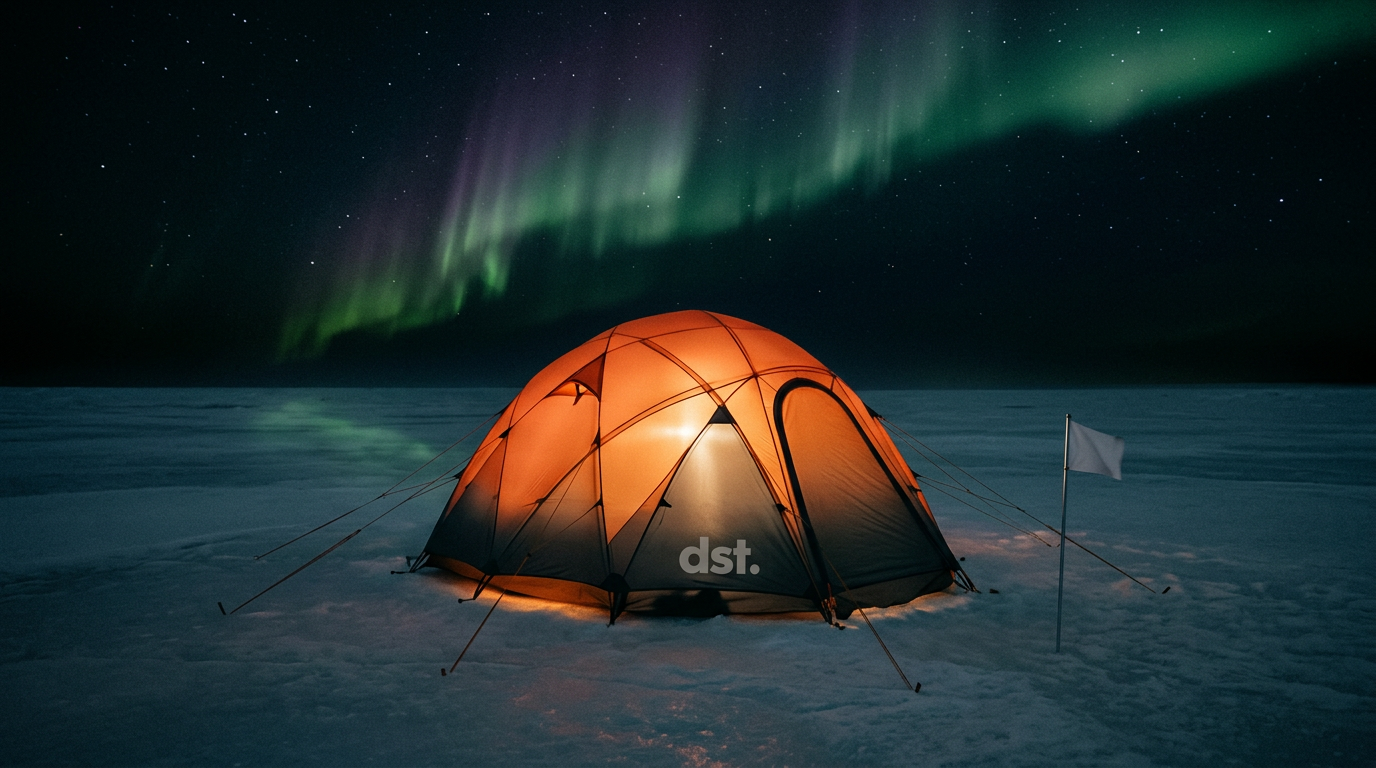
The image on this cover is one we made in Weave. An expedition tent on an Arctic ice shelf, glowing from within against total darkness. We chose it because that is what exploring a new tool feels like right now. You are in unfamiliar territory with no clear sense of where it leads. The tent is not a statement; it is a basecamp. Somewhere to set up so you can go a bit further. That is where DST is with AI - curious enough to be out there, but not pretending we have it worked out yet.
What it actually is
Weave is a node-based creative platform that gives you access to multiple AI models and professional editing tools in a single canvas. Think of it as a visual workflow environment where you connect inputs, models, and editing steps as nodes, and the output flows through each one in sequence.
The model lineup is broad: Google, OpenAI, Runway, Kling, Luma, Recraft, and more. Rather than bouncing between tabs and platforms to get what you need from different providers, Weave brings them together in one place so they can work in combination. That is the real proposition here, not simply AI image generation, but a compositing and workflow environment where AI sits as one considered layer among many professional editing tools. Inpaint, outpaint, relight, upscale, mask extraction, z-depth, painter, channels. The kind of tools that take a generated image and make it production-ready.
To understand what that looks like in practice, it helps to see someone using it with genuine creative intent. A flow by creative director Rory Flynn called Photoshoot is a good example. It takes a reference image of a car and a series of Kodak film packaging images as a style reference, then uses a node pipeline to art-direct an entire photoshoot from scratch. The car design feeds in from one branch, the Kodak visual language from another, and the nodes bring them together across multiple generation streams, producing a grid of dramatic, neon-lit scenes that look as if they were shot on location and graded in post.
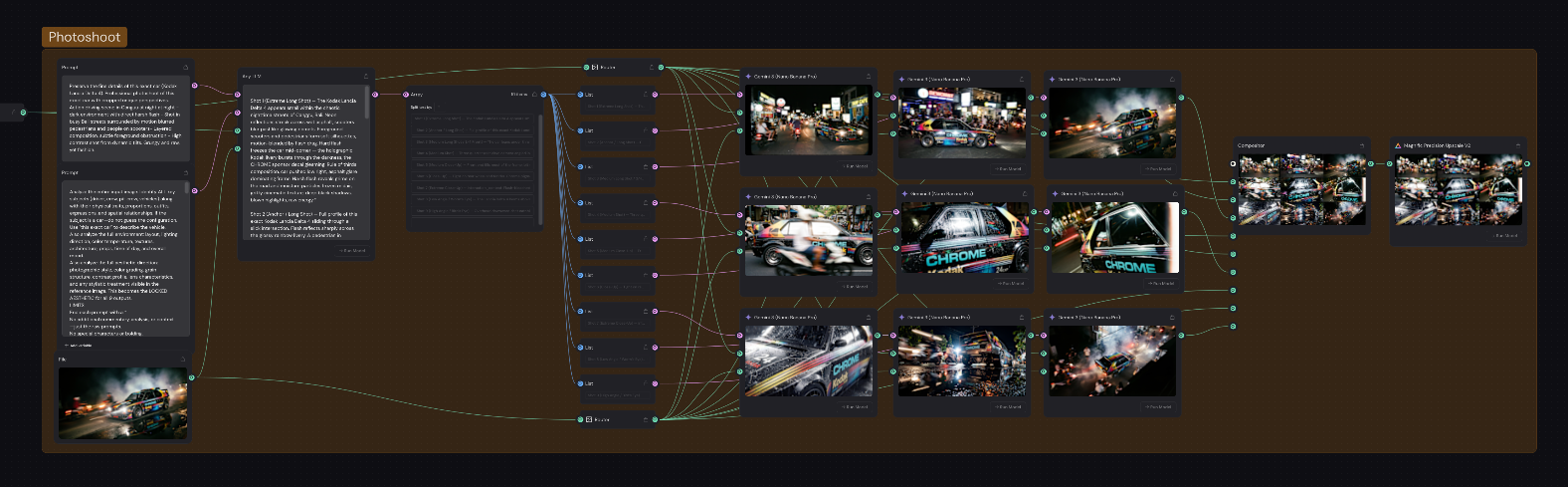
The point is not that AI did the creative thinking. The point is that someone with a clear idea, a strong reference, and an understanding of how to build a workflow got from concept to a fully realised visual direction without a single light, camera, or location booking. The node structure made that creative logic visible and repeatable. That is the part that interests us.
Why we tried it
Honesty first: we were not chasing a trend. Can a tool like this meaningfully support our creative process rather than replace it?
At DST, the thinking always comes before the making. Weave became interesting to us as an ideation and exploration tool. Could it help us get visual concepts onto the canvas faster during the early stages of a project? Could it give us something to react to, push back against, or build on? The answer, in short, was yes, and sometimes no.
How we have been using it
The most immediate thing Weave changed for us was the speed at which we can test a big visual idea.
Concepting has always been one of the most time-intensive parts of creative work. Before you can show a client a direction, someone has to build it. That has traditionally meant hours in Photoshop, sourcing or shooting assets, compositing layers, getting something to a point where it communicates the idea well enough to get a reaction. By that stage, you are already fairly committed to a concept, even if you would not admit it.
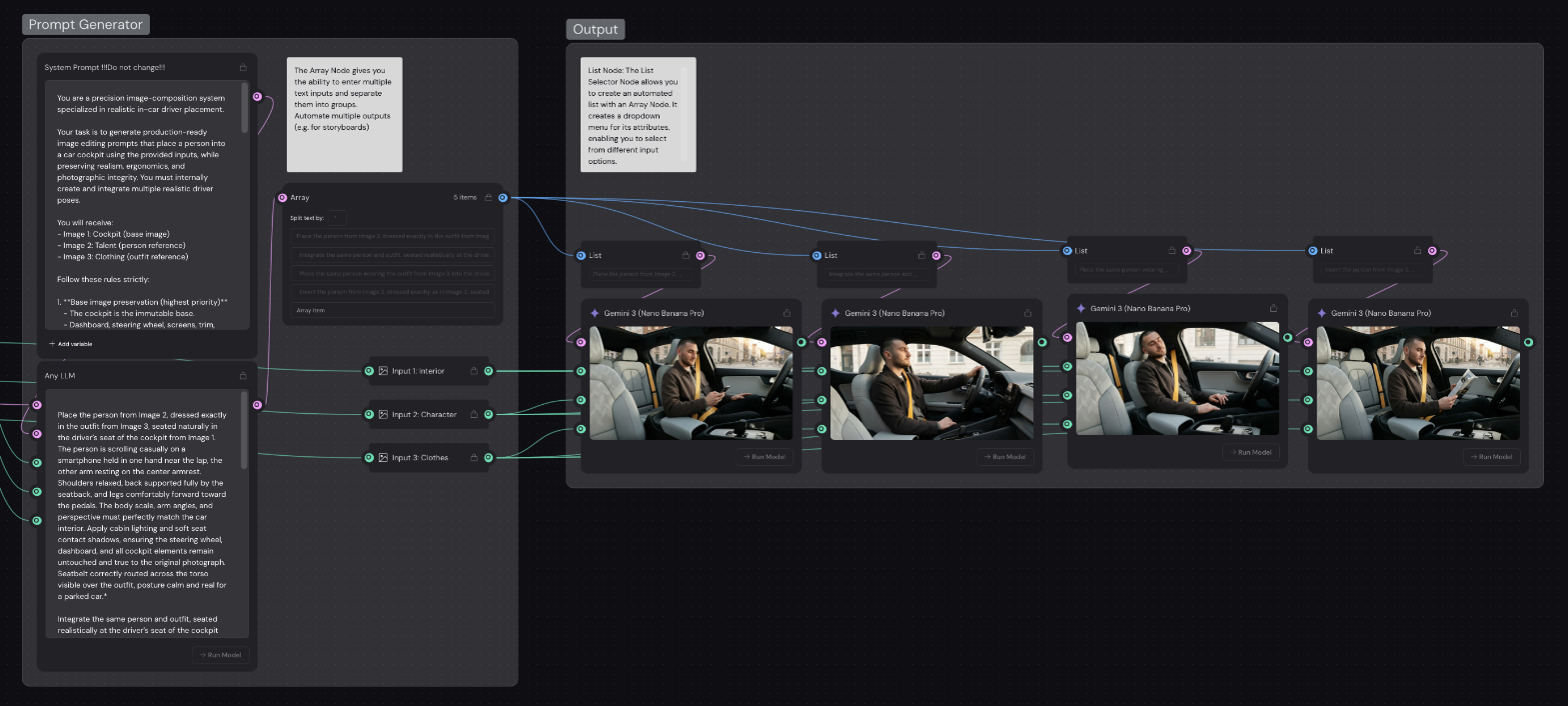
Weave collapses that process significantly. We can take a visual idea from a brief, articulate it as a node-based workflow, run it through multiple models, and have something genuinely explorable on screen in a fraction of the time. Not a rough sketch, but something with real atmosphere, real light, real compositional intent. The kind of output that lets a creative team say "yes, this direction" or "no, not this" without anyone spending a day building a dead end.
What surprised us was how useful it became as a texture-and-atmosphere tool, particularly for backgrounds, abstract compositions, and mood pieces where photographic stock was not cutting it. It opened up visual territory that would have been time-consuming to explore through traditional art direction. Fast, experimental, and occasionally remarkable.
Where it fell short was in the precision work. When a visual needed to carry real brand weight, meet a specific stylistic brief, or depict something specific, the limitations became apparent. That is not a failure of the tool; it is a feature boundary. And knowing that boundary is valuable.
What we are clear about
AI at DST is a tool in service of human creative thinking, not a replacement for it. We call it Creative Intelligence: the combination of strategic insight, design expertise, and genuine craft that no model generates on its own.
Weave is useful to us precisely because it amplifies what the team already knows how to do. The node workflows we build reflect the creative decisions of experienced designers. The outputs we keep are the ones that meet a brief, serve a client's brand, and hold up under scrutiny. The speed it provides gives us more room to think, not less. More concepts explored means more considered choices, and that is where human work becomes more valuable, not less necessary.
What it means for our clients
DST has always been selective about the tools we recommend and the processes we adopt. This experiment reinforced something we already believe: AI tools work best when they sit inside a strong creative framework, not outside it. Weave in the hands of a designer who knows what they are building, is a different proposition to Weave used in isolation.
For clients, the upside is speed and variety at the concept stage. More visual options explored more quickly, with the same rigour applied to what makes the final cut. We can bring more fully-formed creative thinking to the table earlier in a project, and that is better for the work.
We will keep using Weave where it earns its place. That is the only honest answer.